CG Policy · 2025
In this section7 topics
Corporate Governance Policy
Has a Corporate Governance Policy
Yes
Policy Description
The Board of Directors realizes and strives to promote and create value for the sustainability of the Company and its subsidiaries in business operations, management, including governance with emphasis on transparency, fairness, being able to be audited, and responsibility. They are on the basis of having professional ethics, a code of business conducts, and good morals, including striving to create the best interests of all stakeholders in the value chain as well as creating a better business standard. These will enable all stakeholders to gain confidence, create a good image of the Company as well as lead to truly sustainable business development.
The Board of Directors has established a written corporate governance policy for directors, executives and employees of all levels to adhere to and comply with as follows:
1. The Board of Directors will abide based on policies and guidelines related to the performance of duties of the Board of Directors, which it covers nomination and remuneration for directors and top management. Independence from management, director development and performance evaluation, including supervision of subsidiaries and associated companies, and others.
2. The Board of Directors will set a visible vision, management structure, strategy, as well as responsible for the safety of the personnel, property and the environment both in the organization and nearby communities including guidelines for working with transparency, able to monitor, tracking and measure business performance systematically as well as the effectiveness of risk management, independence and responsibility for the performance of their duties in accordance with good corporate governance principles, performing duties in accordance with the law strictly and carefully considering the relevant regulations in all countries that has invested in.
3. The Board of Directors encourages employees at all levels to comply with good corporate governance principles as well as policies and practices relating to shareholders and stakeholders of all groups. Covering responsibility for shareholders, equality, promoting the exercise of shareholders’ rights, prevention of the use of inside information, prevention of conflicts of interest, responsibility for all groups of stakeholders. Compensation for infringement, anti-corruption and measures to act against those who do not comply with policies and guidelines.
4. The Board of Directors encourages employees at all levels to comply with the rules and regulations of the company as well as the regulation that along with the announcement of the Stock Exchange of Thailand, the Capital Market Supervisory Board and the laws relating to the business conduct strictly and continuously monitor changes.
5. The Board of Directors has to review the appropriateness and approve the good corporate governance policy at least once a year, as well as establishing a system for inspection, monitoring, evaluation, and review for employees of all levels to adhere and practice in order to reach sustainability.
The Board of Directors has acted as a role model in corporate governance by encouraging senior management and executives to follow with a commitment to conduct their business on the basis of social, community, and environmental responsibility, based on the sustainable development guidelines of the relevant departments. Additionally, the Board of Directors has assigned the Audit Committee to supervise and review by reporting the results of good corporate governance to the Board regularly at least once a year or if any related changes, as well as reporting to the public via Form 56-1 One Report and SD Report. Please see “Corporate Governance Report (CG Report)”.
Policy Document Link
https://www.tndt.co.th/en/sustainability/sustainability-governance/
Policy & Practices — Board of Directors
Has Policy & Guidelines for the Board
Yes
Board Guidelines
| Guideline | Detail | Document Link | ||||||||||||||||||||||||||||||||||||||||||||||||||||||||||||||||||||||||||||||||||||||||||||||||||||||||||||||||||||||||||||||||||||||||||||||||||||||||||||||||||||||||||||||||||||||||||||||||||||||||||||||||||||||||||||||||||||||||||||||||||||||||||||||||||||||||||||||||||||
|---|---|---|---|---|---|---|---|---|---|---|---|---|---|---|---|---|---|---|---|---|---|---|---|---|---|---|---|---|---|---|---|---|---|---|---|---|---|---|---|---|---|---|---|---|---|---|---|---|---|---|---|---|---|---|---|---|---|---|---|---|---|---|---|---|---|---|---|---|---|---|---|---|---|---|---|---|---|---|---|---|---|---|---|---|---|---|---|---|---|---|---|---|---|---|---|---|---|---|---|---|---|---|---|---|---|---|---|---|---|---|---|---|---|---|---|---|---|---|---|---|---|---|---|---|---|---|---|---|---|---|---|---|---|---|---|---|---|---|---|---|---|---|---|---|---|---|---|---|---|---|---|---|---|---|---|---|---|---|---|---|---|---|---|---|---|---|---|---|---|---|---|---|---|---|---|---|---|---|---|---|---|---|---|---|---|---|---|---|---|---|---|---|---|---|---|---|---|---|---|---|---|---|---|---|---|---|---|---|---|---|---|---|---|---|---|---|---|---|---|---|---|---|---|---|---|---|---|---|---|---|---|---|---|---|---|---|---|---|---|---|---|---|---|---|---|---|---|---|---|---|---|---|---|---|---|---|---|---|---|---|---|---|---|---|---|---|---|---|---|---|---|---|---|---|---|---|---|---|
| Nomination of Directors | The Company and the Nomination and Remuneration Committee should be responsible for nominating the qualified directors of each Board/Committee, with the policy of board diversify by the features of knowledge, skill, and expertise in the Company’s business and the related industries, specific profession, beneficial experiences for the business, appropriate gender, age and qualification, including the essential proficiency to achieve the objectives and goals of the organization and the Board Skill Matrix, in order for the achievement of the Company’s objectives and stakeholders’ interests efficiently. The Professional Search Firm or the Director Pool of the Thai Institute of Director (IOD) would be the channels of nomination as well. Guidelines
The Nomination and Remuneration Committee of the Company has the authority and responsibility in nominating and selecting. In all, the persons who will be appointed to be the Company’s Directors and Top Executives must have qualifications according to the Section 68 of the Public Company Act B.E. 2535 and the Company’s regulations. Moreover, the Directors and Executives must not have prohibited characteristics according to the Notification of Capital Market Supervisory Board No. Tor.Jor. 28/2551 concerning Request and Permission for New Share Issuance dated 15 December 2008, the selection process and criteria are as follows: 1. The Board of Directors Selection Process and Relevant Issues Board member selection, appointment and termination process and relevant issues are determined in the Company’s Regulations, which can be concluded as follows: (1) The Board of Directors shall comprise of no less than 5 members and no more than 15 members. The Board Members are appointed by the shareholders’ meeting. The Board must consist of at least 3 directors, 3 years tenure/each, and 1/3 of Directors shall retire by rotation on the AGM of Shareholders. The Board of Directors consists of 9 Directors, they are (1) 2 Executive Directors, 1is a female director, having managerial skills, knowledgeable in the Company’s business and discretionary in management, and (2) 7 Non-Executive Directors, 4 are Members of the Independent Directors are 3 Audit Committee and Non-Executive Directors (more than 1/3 of the entire Board) and 3 are Non-Executive Directors, having various knowledge and expertise, which is the best interests of the Company’s operations. In these, at least half of the board members must reside in Thailand. (2) Independent Director must be qualified in accordance with the Notification of the Capital Market Supervisory Board No. Tor Chor. 4/2552 Re: concerning Request and Permission for New Share Issuance (Vol. 2). Definition of “Independent Director” Independent Director refers to a Director whose qualifications are in line with the requirements of the Office of the Securities and Exchange Commission (SEC) and the Stock Exchange of Thailand (SET), as follows; 1) Holding shares not exceeding 0.5% of the total shares with voting right of the Company, its parent company, subsidiaries, associates, major shareholders, and controlling parties of the Company, provided that the shares held by the related parties of such Independent Director shall be included. (including the connected persons as stipulated in section 258 of the Securities and Exchange’s Act) 2) Being not or has never been an Executive Director, staff, employee, advisor who receives salary, nor controlling parties of the Company, its parent company, subsidiaries, associates, same level subsidiaries, major shareholders, controlling parties of the Company or entities may have a conflict. Unless it is clear from the mentioned manner for not less than 2 years before his appointment as a Director. 3) Being not the person who has relationship by means of descent or legal registration under the status of father, mother, spouse, brothers and sisters, and children. The prohibitive persons also include spouses of daughters and sons of executives, major shareholders, controlling party or the person who is in the process of nomination to be the management or controlling party of the Company or its subsidiaries. 4) Having no or never have business relationship with the Company, its parent company, subsidiaries, associates, major shareholders, controlling parties of the Company or entities may have a conflict in respect of holding the power which may cause the obstacle of the independent decision, including not being or never been the significant shareholder, or controlling parties of any person having business relationship with the Company, its parent company, subsidiaries, associates, major shareholders, controlling parties of the Company or entities may have a conflict. Unless it is clear from the mentioned manner for not less than 2 years before his appointment as a Director. 5) Being not the Director who is nominated to be the representative of Directors of the Company, major shareholders, or any other shareholder related to the major shareholders. 6) Being not or has never been the auditor of the Company, its parent company, subsidiaries, associates, major shareholders, or controlling parties of Company, and is not the significant shareholder, controlling parties, or partner of the auditing firm which employs such auditor of the Company, its parent company, subsidiaries, associates, major shareholders, or controlling parties of the Company. Unless it is clear from the above manner for not less than 2 years before his appointment as a Director. 7) Being not or has never been the professional service provider, including but not limited to legal service or financial advisor with received the service fee more than 2 million per year from the Company, its parent company, subsidiaries, associates, major shareholders, or controlling parties, and is not the significant shareholder, controlling parties, or partner of the above-mentioned service firms. Unless it is clear from the mentioned manner for not less than 2 years before his appointment as a Director. 8) Doing not operate the same and competitive business with the business of the Company, or its subsidiaries, or is not a significant partner of the partnership, or is not an executive director, employee, advisor who receives salary, nor holds share for more than 0.5% of the total shares with voting right of any other company which operates same and competitive business with the business of the Company, or its subsidiaries. 9) Being no any characteristic, which is unable to have the independent opinion regarding the business operation of the Company. Remark: (3) The shareholders’ meeting shall select the board members using criteria and procedures as follow. 2) A shareholder shall have votes according to the item (1) to vote for a candidate or multiple candidates, but, for the latter case, the vote may not be distributed for any particular candidates in any particular order. (4) During every Annual General Shareholders’ Meeting, a-third of Board members at that time must retire by rotation. If the number of directors cannot be indivisible by 3, the closest number to a-third shall be used. The retired directors during the first and second years will be selected by taking draws. For the following years, the directors who are in the longest position shall be retired. The retired directors may be re-appointed to the positions. (5) Any director who wishes to resign from the position must submit the resignation letter. Such letter shall be effective on the date it reaches the Company. (6) To vote any director out of the position prior to the rotation period, the motion require 75% of total participating votes in the shareholders’ meeting with shares no less than half of total shares held by participating shareholders.
Process and Relevant Issues The Company’s Audit Committee must be of the Company’s Directors, appointed by the Board of Directors. All of the Audit Committee members are not Executives, Employees, Consultants of the Company and possess all required qualifications as stipulated by the SET and any relevant announcement, Regulations, and/or order of the SET. The Audit Committee shall consist of no less than 3 members with at least a member proficient in finance and accounting. The term of tenure is 3 years, and not more than 9 years continued or 3 terms. 3. Nomination and Remuneration Committee Member Selection Process and Relevant Issues The Company’s Nomination and Remuneration Committee shall consist of 3 members, they are 1 Non-Executive Director and 2 Independent Directors. The Resolutions of the Board of Directors has appointed the Nomination and Remuneration Committee by the Meeting No. 6/2014 held on November 10, 2014, while more than half of the entire members must be Independent Directors, and the Chairman of the Committee must be Independent Director. The 3 members must have qualifications as determined by the SEC Regulations and any relevant announcement, regulations, and/or order of the SET, together with having a 3 year term of tenure, and not more than 9 years continued or 3 terms from the date of appointment. 4. Executive Committee Selection Process and Relevant Issues The Board of Directors shall appoint the Executive Board from the Board members and/or management team as appropriate. The Board of Directors shall appoint a board member to preside over the Executive Board as the Chairman of the Executive Board. The Executive Board will manage the business as assigned by the Board of Directors or the resolution of the shareholders’ meeting. 5. Investment Committee Selection Process and Relevant Issues The Investment Committee shall comprise of no less than 3 directors and/or executives of the Company and/or external consultants, appointed by the Board of Directors or management assigned by the Board of Directors, and the Board of Directors shall appoint one of the Investment Committee members as the Chairman of the Investment Committee. The Investment Committee shall be the executive, screening investments in various projects to ensure that the Company’s investment projects are linked and consistent with the policies and goals of the investment plan. 6. Sustainable Development Committee Selection Process and Relevant Issues The Sustainable Development Committee shall comprise of the Company’s directors and/or executives and/or employees of the Company, appointed by the Board of Directors or the management assigned by the Board of Directors, and shall consist of the number deemed appropriate by the Board of Directors, but shall not be less than 3 persons in total. The Board of Directors shall appoint one Sustainable Development Committee member as the Chairman of the Sustainable Development Committee. The Sustainable Development Committee shall manage the Company’s business in order to support, promote, and consider plans and budgets for the Company’s sustainable activities. 7. Executive Selection Process and Relevant Issues Please see “Principle 4 : Ensure Effective CEO and People Management” the title of “2. Top-Executives and Executives Nomination”, page 218-219 | https://www.tndt.co.th/en/sustainability/sustainability-policy/board-diversify-policy/ | ||||||||||||||||||||||||||||||||||||||||||||||||||||||||||||||||||||||||||||||||||||||||||||||||||||||||||||||||||||||||||||||||||||||||||||||||||||||||||||||||||||||||||||||||||||||||||||||||||||||||||||||||||||||||||||||||||||||||||||||||||||||||||||||||||||||||||||||||||||
| Determination of Director Remuneration | The Board of Directors has assigned the Nomination and Remuneration Committee (NRC), in which exclude the executive directors, acting in determining, considering and monitoring the remuneration structure of The Board of Directors, Managing Director (CEO), Top Executives and Executives. In addition, the NRC would monitor the assessment of performance in accordance with the specific criteria, to apply for the information in determining proper compensation for the short-term and long-term, including communicating the executives at all levels to acknowledge. In this regard, each step of process could be performed to the employees at all levels as well. Guidelines The Directors The Board would assign the Nomination and Remuneration Committee to consider the remuneration of the Directors appropriately and transparently by comparing to other companies in the similar fields and in the same level, including the duties, responsibilities and also considering the expansion of the business and the growth of the Company’s profit which should be sufficient to attract and retain valuable and qualified Directors. The remuneration of Directors in each year would be allocated from the remaining balance after the meeting allowances have been deducted, and would be presented to the Board of Directors for approval and further propose to the Shareholders Meeting for approval. In this, the Directors who were given more duties and responsibilities would be rewarded more to compensate with the tasks given.
Managing Director (CEO) Remuneration of the Executives are determined annually by the Managing Director, in accordance with the policy of the Nomination and Remuneration Committee designated, being in line with the Company’s operating results both in the short term and in the long term, by applying the individualized metrics (KPIs) to determine fairly and equitably. The results of the assessment would be applied for managing the rewards and considering career path advancement, to create incentives along with the development and increase the potential of executives.
Top Executives Remuneration of the Executives are determined annually by the Managing Director, in accordance with the policy of the Nomination and Remuneration Committee designated, being in line with the Company’s operating results both in the short term and in the long term, by applying the individualized metrics (KPIs) to determine fairly and equitably. The results of the assessment would be applied for managing the rewards and considering career path advancement, to create incentives along with the development and increase the potential executives. 1. Remuneration of Directors (1) Remuneration in Cash. During the General Shareholders’ Meeting No. 19/2025 on April 25, 2025, the shareholders’ meeting approved the Directors, Nomination and Remuneration Committee, and Audit Committee remuneration package of Baht 2,500,000.00 in total for the normal meeting and remuneration allowance. The meeting allowance of ; - Chairman of the Board, Chairman of the Nomination and Remuneration Committee, and Chairman of the Audit Committee were at Baht 15,000.00 each - Directors, Nomination and Remuneration Committees, and Audit Committees were at Baht 10,000.00 each. (2) Other Remunerations. No any other benefits and compensation than the meeting and remuneration allowances under item (1), if any, shall be included in the remuneration of directors for the year 2025. (3) The meetings in year 2025. - 9 meetings of the Board of Directors - 6 meetings of the Audit Committee - 5 meetings of the Nomination and Remuneration Committee - 2 meetings of the Executive Committee (no meeting and remuneration allowances). - 2 meetings among the Non-Executives and Independent Directors/Members of the Audit Committee, without the attendance of the Executives (no meeting and remuneration allowances). (Unit : Bath)
Notes:
2. Managing Director’s Remuneration (1) Remuneration in Cash. Managing Director’s remuneration in cash from the Company are salary and other income, provident fund, and bonus (if any). (2) Other Remunerations. - Vehicles for the Company Management Affairs. - Other expenses and benefits according to the Company’s Rules and Regulations. 3. Executives’ Remuneration (1) Remuneration in Cash. In the year 2025, total of 5 Executives from division managers or higher received total remuneration in cash from the Company. They are salary and other income, provident fund, and bonus (if any). (2) Other Remunerations - Vehicles for the Company Management Affairs. - Other expenses and benefits according to the Company’s Rules and Regulations.
4. Employees’ Remuneration. (1) Remuneration in Cash. The Company’s policy in remunerating for its employees is on the basis of appropriateness, fairness, knowledge, capability, performance, and compatibility with the industry’s average pay scale. Moreover, the employees’ remuneration must be appropriate to the business expansion and the Company’s growth. In the year 2025, the total remuneration which the employees received in cash from the Company are salary and other income, provident fund, professional fee, and bonus (if any), etc. The Company has established provident fund in the Company’s name for all the Company’s employees by appointing Kasikorn Fund Management Company Limited as the fund manager, starting from 1 January 2005. The Company would contribute to the fund at the amount 5-10% of employees’ salary, depending on working duration. The employees shall contribute no less than 5% of salary, anyway no exceeding the amount contributed by the Company. Since January 1, 2017, onwards, the Company’s provident fund has been transferred to the K Master Pool Fund of Kasikorn Fund Management. The employees can contribute at 5-15% of employees’ salary since starting the membership, while the Company still contributes to the fund at the same rate at 5-10%. The purposes are for the employees’ capabilities to select individual investments as appropriate, in order to generate the good returns in both short and long term. The returns are based on the age and type of funds they select, so as them to save for the future and/or financial security after retirement. Currently, there are 30 fund members. (2) Other Remunerations Moreover, the Company has provided various benefits for employees according to the law. The Company has adjusted and increased its welfare and fringe benefit offering to the employees, for example, healthcare payments, group life and accident insurance and annual health check for employees, and other types of financial and non-financial assistance such as funds for the funeral arrangements of employees, their parents, children or legal spouse, the marriage, the monk ordinations, emergency loan, preparing reliable sources providing the loan with special interest rate for housing, etc.
5. Number and Level of Employees. (1) Number of Employees.
(2) Level of Employees.
6. Significant changes in the number of employees in the past 3 years. - None - 7. Major labor disputes in the past 3 years. - In September 2022, the Company was named as a defendant in a labor lawsuit filed with the Central Labour Court, involving a total claim of Baht 240,000.00. The case has reached its conclusion, and the Company has completed the payment of compensation to the employee. | https://www.tndt.co.th/en/sustainability/sustainability-policy/policy-for-remuneration-of-directors--ceo---executives/ | ||||||||||||||||||||||||||||||||||||||||||||||||||||||||||||||||||||||||||||||||||||||||||||||||||||||||||||||||||||||||||||||||||||||||||||||||||||||||||||||||||||||||||||||||||||||||||||||||||||||||||||||||||||||||||||||||||||||||||||||||||||||||||||||||||||||||||||||||||||
| Independence of the Board of Directors from the Management | The Board of Directors recognizes and is committed to its role as corporate leaders in promoting and creating sustainable value for the Company and its subsidiaries. This commitment covers business operations, management, and oversight, with an emphasis on transparency, fairness, accountability, and responsibility, grounded in professional ethics and integrity. The Board is dedicated to maximizing benefits for all stakeholders throughout the value chain to elevate corporate standards, build stakeholder confidence, enhance the Company’s image, and lead to truly sustainable business development. To this end, the Board of Directors has established a written Corporate Governance Policy as a guideline for directors, executives, and employees at all levels. This policy is reviewed for appropriateness and approved at least once a year. Regarding the independence of the Board from management, the guidelines are as follows: Guidelines
| https://www.tndt.co.th/en/sustainability/sustainability-governance/ | ||||||||||||||||||||||||||||||||||||||||||||||||||||||||||||||||||||||||||||||||||||||||||||||||||||||||||||||||||||||||||||||||||||||||||||||||||||||||||||||||||||||||||||||||||||||||||||||||||||||||||||||||||||||||||||||||||||||||||||||||||||||||||||||||||||||||||||||||||||
| Director Development | The Board of Directors has assigned the Nomination and Remuneration Committee (NRC) to oversee, monitor, and prepare the development plan for the directors of each board and committee according to the Skill Matrix. They are for the Board of Directors, Top Executives, including the Company Secretary, to develop skills, knowledge, and related capacities regularly and every time on a change of laws, rules, and regulations related to the Company's business. The NRC should consider appropriately, in accordance with the notifications, regulations, laws, and regulations related to the business of the company. Moreover, the orientation for new directors should be provided by focusing on the performance of the directors to achieve the objectives, goals, and benefits for the organization. Guidelines The Directors
In 2025, a total of 5 directors attended 20 training courses and development programs. Furthermore, one newly appointed director has already completed the training certification provided by the Thai Institute of Directors (IOD). Orientation for the New Director Taking a position as new director, he/she will take an orientation to acknowledge significant information about the nature, structure and guidelines of the Company’s business, including the objectives, goals, vision, mission, corporate values as well as legal advice, rules and conditions of being a listed company director on the listed company in the SET, in which are the relevant notifications, regulations and the Public Company Act, the Company Board’s regulations, adequately before performing his/her duty. They are in accordance with the Board Orientation Guideline of the SET. The Board also promotes and encourages new director to attend training, seminars on the courses related to the duty, there are courses of the Thai Institute of Directors Association (IOD), especially the Director Certification Program (DCP), Director Accreditation Program (DAP), including the SEC, the SET and other related association. They are for developing knowledge, capabilities and increasing skills continuously, which are beneficial to the performance of duty of director and are in accordance with the director development plan. This is done to comply with relevant laws and regulations and report to the board of directors in the next board meeting as well. | https://www.tndt.co.th/en/sustainability/sustainability-policy/policy-for-the-development-of-directors-company-secretary-and-secretary-to-the-sub-committees-/ | ||||||||||||||||||||||||||||||||||||||||||||||||||||||||||||||||||||||||||||||||||||||||||||||||||||||||||||||||||||||||||||||||||||||||||||||||||||||||||||||||||||||||||||||||||||||||||||||||||||||||||||||||||||||||||||||||||||||||||||||||||||||||||||||||||||||||||||||||||||
| Board Performance Evaluation | The Nomination and Remuneration Committee would review the assessment form together and present them to the Board of Directors. The Board of Directors and the Members of Sub-Committees would assess their performance together and assess the sufficiency of the internal control system by using the Self-Assessment form of the Board of Directors, by applying the form of the SET to suit for the Company, and utilize the results to develop and improve the business operations, to achieve the assigned goals. The Company would provide the Self-Assessment of the Board of Directors annually by the 4th quarter, and would be done in 2 ways. These were done for the assessment of the effectiveness of the Board’s performance on good corporate governance. The process would be as follows: -
The Board of Directors would assess their performances as a whole which would cover 6 different categories, they were:-
The Director would assess his/her performance as an individual which would cover 5 different categories, they were:-
| |||||||||||||||||||||||||||||||||||||||||||||||||||||||||||||||||||||||||||||||||||||||||||||||||||||||||||||||||||||||||||||||||||||||||||||||||||||||||||||||||||||||||||||||||||||||||||||||||||||||||||||||||||||||||||||||||||||||||||||||||||||||||||||||||||||||||||||||||||||
| Corporate Governance of Subsidiaries and Associated Companies | The Company has established a governance policy for its subsidiaries and associates, outlining direct and indirect measures and mechanisms. This ensures the Company can efficiently oversee and take responsibility for their management at an appropriate level. The policy enables the monitoring of their administration as if they were business units of the Company, thereby protecting investment interests and enhancing shareholder confidence. In cases where specific transactions or actions by a subsidiary or associate require approval from the Company’s Board of Directors and/or Shareholders' Meeting, the Company’s Board shall convene a meeting to consider such matters prior to the subsidiary or associate holding its own meeting. The Company shall ensure full disclosure and compliance with relevant laws and regulations. However, this policy shall not apply if it contradicts the laws or regulations of a foreign country applicable to those entities, or if it would result in the loss of legal benefits for foreign subsidiaries or associates. To safeguard its investment interests, the Company has established the following governance mechanisms: Guidelines
| |||||||||||||||||||||||||||||||||||||||||||||||||||||||||||||||||||||||||||||||||||||||||||||||||||||||||||||||||||||||||||||||||||||||||||||||||||||||||||||||||||||||||||||||||||||||||||||||||||||||||||||||||||||||||||||||||||||||||||||||||||||||||||||||||||||||||||||||||||||
Code of Conduct
Has a Business Code of Conduct
Yes
Code of Conduct Description
The Board has established guidelines/policies to be observed in the Company's business operations and the performance of directors, executives, employees, and relevant stakeholders, to ensure awareness and adherence to principles, as well as consistent practices. leading to continued mutual sustainable growth.
The Board of Directors has assigned the Audit Committee the duty to oversee and review, reporting the results of business ethics operations to the Board of Directors at least once a year or whenever there are relevant changes.
At the Board of Directors Meeting No. 1/2569 on February 27, 2569, the Board of Directors reviewed the business ethics. (Revised Edition 2023) and provided to directors and executives, disseminated to all company employees through the company's internal information system, including the internet, and made public, to promote good practices that the company expects all directors, executives, and employees to be aware of.
In the past year, there have been no complaints regarding violations of the business ethics, and/or corruption, and/or morality of the company whatsoever.
Operational Guidelines
The Company is committed to developing the organization to keep pace with contemporary changes for stability and sustainability in business operations.
The Company will conduct its business in accordance with international standards, safety standards, laws related to the Company's operations, including the regulations of the Stock Exchange of Thailand and other relevant laws.
The Company believes that conducting business within the bounds of honesty, virtue, and ethics is a sound business policy that will lead to the sustainable growth of the Company's business.
The Company will respect and adhere to the local customs and traditions.
The Company will conduct business with integrity, implementing financial policies, budget frameworks, and investment evaluations for various projects rigorously and transparently.
The Company expects all directors and employees to adhere to the Company's policies, accounting processes, and other control criteria. In cases where there is suspicion of a violation of organizational ethics that may lead to misconduct or damage the Company's reputation, employees can report or complain to the management team immediately.
The Company provides training to employees to enhance their knowledge and understanding of work ethics.
all levels, including verification of the ability to adhere to/comply with the established code of conduct.The Company requires quarterly reports summarizing violations of the code of conduct, in cases where the audit committee
find suspicious observations, or if there are significant whistleblowing reports or complaints, these should be reported to the Board of Directors immediately.
to identify causes and implement corrective actions, as well as to find ways to prevent recurrence.
Code of Conduct Link
https://www.tndt.co.th/en/sustainability/sustainability-conduct/
Code of Conduct Practices
| Guideline | Detail | Document Link |
|---|---|---|
| Prevention of Misuse of Inside Information | Policy The Company conducts its business based on good corporate governance, professional ethics, transparency, accountability, and considers the best interests of all stakeholders, in compliance with laws, regulations, and various requirements, while avoiding actions that create conflicts of interest that may affect any decisions. Guidelines have been established for directors, executives, employees, and related parties to adhere to and practice. Guidelines
| |
| Anti-corruption | Policy The Company adheres to and emphasizes conducting business with honesty, fairness, social responsibility, and all stakeholder groups, by adhering to principles of good corporate governance, ethics, business code of conduct, and the Company's work practices, as well as strictly complying with both public and private sector regulations. This includes overseeing the Company's development of anti-corruption policies and guidelines, as well as processes for training, promoting, and instilling in employees knowledge of the Company's anti-corruption policies and practices, along with fostering the prohibition of bribery for business benefits, and recognizing the duty to act with honesty and integrity, and regularly monitoring performance to prevent risks from fraud and corruption. <8kH0vEdyN2Wd> Directors, executives, employees, and workers of the Company are prohibited from using their authority, whether directly or indirectly, to seek benefits for themselves or others, including prohibiting the offering of unlawful inducements to any other person to obtain business benefits for the Company. The Company arranges for monitoring, reviewing compliance, and regularly assessing corruption risks at least annually. 1 times, as well as reviewing practices and requirements. requirements for operations to align with changes in business, regulations, rules, and legal requirements. ” The Company communicates and provides knowledge to everyone in the Company through Information Technology System announcements and training. to foster understanding of the requirements, operational guidelines, and responsibilities, so that everyone in the organization, including relevant parties, is aware and complies under the same policy. Guidelines
Measures for preventing and combating corruption The Company has implemented measures to prevent and combat corruption for directors, executives, and employees to adhere to as a guideline. It has also adopted an anti-corruption policy alongside all its operational activities, and regularly assesses potential corruption risks across all processes. In cases where acts indicating corruption or misconduct are found, employees at all levels, including all stakeholder groups, can report through channels designated by the Company for data verification, correction, and prevention, as well as reporting to the Board of Directors to prevent and monitor corruption risks. Whistleblowers / Complainants can consider appropriate reporting channels. Furthermore, the Company also has measures for investigation and disciplinary penalties for the Company and / or relevant laws. If the whistleblower or complainant can be contacted, the Company will inform them of the outcome in writing. Furthermore, the Company has an internal audit committee responsible for conducting audits according to the quarterly audit plan and reporting to the Audit Committee. / Independent directors review and present to the Board of Directors for acknowledgment and jointly determine appropriate corrective actions. | https://www.tndt.co.th/en/sustainability/sustainability-anticorruption/anti-corruption-policy/ |
| Whistleblowing and Protection of Whistleblowers | Policy The Company values the participation of all employees and stakeholders, and has therefore established channels for reporting tips, complaints, opinions, or suggestions that are beneficial to the Company's business operations, or for reporting cases of non-compliance with business ethics or illegal acts. The Company will consider and proceed with transparency and fairness, and will implement measures to protect whistleblowers and all involved parties throughout the consideration process. Guidelines
Thai N.D.T. Public Company Limited No. 19 Soi Ramkhamhaeng 60 Yak 8 (Suan Son 8) Ramkhamhaeng Road Huamark Subdistrict, Bangkapi District, Bangkok 10240
| https://www.tndt.co.th/en/sustainability/sustainability-policy/whistleblowing---complaints---comments-or-suggestions-and-prevention-policy/ |
| Preventing the Misuse of Inside Information | Policy Inside information or material news regarding changes in securities prices that have not yet been disclosed to the public. This is considered information used in business operations and confidential company information, which affects the price of the company's securities traded on the stock exchange. Therefore, directors, executives, and relevant employees must keep such inside information confidential and must not use this inside information to seek undue personal gain for themselves or related parties. Guidelines
| |
| Giving or receiving gifts, entertainment, or business entertainment | Policy The Company conducts its business based on standards, transparency, and auditability. Therefore, it has established a policy to refrain from accepting or giving gifts, presents, hospitality, or any other benefits to prevent corruption and avoid actions that may affect performance. Guidelines
|
Promoting Compliance with the Code of Conduct
Promotes Compliance by Directors, Executives and Employees
Yes
Description
The Company's Board of Directors has established a policy regarding the business ethics for the Board of Directors, executives, and employees. This policy aims to promote and ensure that directors and employees at all levels are aware of and adhere to these ethics as a guiding principle in their conduct. A system is also in place to regularly monitor compliance, making it the duty of executives at all levels to serve as good role models. This includes promoting and raising awareness among employees under their supervision to understand, comprehend, and strictly adhere to the business ethics with honesty, integrity, fairness, and responsibility towards stakeholders, shareholders, and all related parties. The practices related to these ethics will also include disciplinary penalties to prevent any actions that could lead to corruption. This initiative is intended to foster a positive corporate image, build confidence among all stakeholder groups in the company's operations, and contribute to sustainable business development.
Anti-Corruption Networks & Projects
Joined or Declared Intent to Join Anti-Corruption Networks
No
Networks & Projects Joined
| Network / Project |
|---|
| Thai Private Sector Collective Action Against Corruption: CAC |
| United Nations Global Compact (UNGC) |
| Participation of anti-Corruption networks and initiatives |
Material Changes & Developments in CG
Reviewed the CG Policy or Board Charter in the Past Year
Yes
Material Changes or Developments in the Past Year
Yes
Policy Review — Description
Policy Review, Practices, and Oversight
The Company places the highest priority on applying the Corporate Governance Code (CG Code) for listed companies, as established by the Stock Exchange of Thailand (SET), and integrates these principles across all corporate activities. Since the 2019 (B.E. 2562) Annual Report, the Company has adopted the CG Code as its primary operational guideline. In certain areas where full compliance has not yet been achieved, the Company has developed strategic plans and identified appropriate alternative practices to ensure continued business transparency. Further information regarding these specific cases can be found in Section 6.3.2: Application of Corporate Governance Code for Listed Companies, under the heading "Exceptions to the Application of Corporate Governance Code." Page 244-245
Charter
All committees reviewed and revised their respective charters at the Board of Directors Meeting No. 1/2026 on February 27, 2026.
Corporate Governance Report of Thai Listed Companies (CGR) Project
Since 2019, the Company's Board of Directors has considered, reviewed, and monitored operations, and has adopted all 8 principles of good corporate governance (CG Code) from the SEC Office. Additionally, in 2025, the Corporate Governance Report of Thai Listed Companies 2024 or CGR 2025 from the Thai Institute of Directors Association was applied and adapted to ensure the company achieves good performance, maintains credibility with all stakeholder groups, benefits society as a whole, and creates sustainable value for the business.
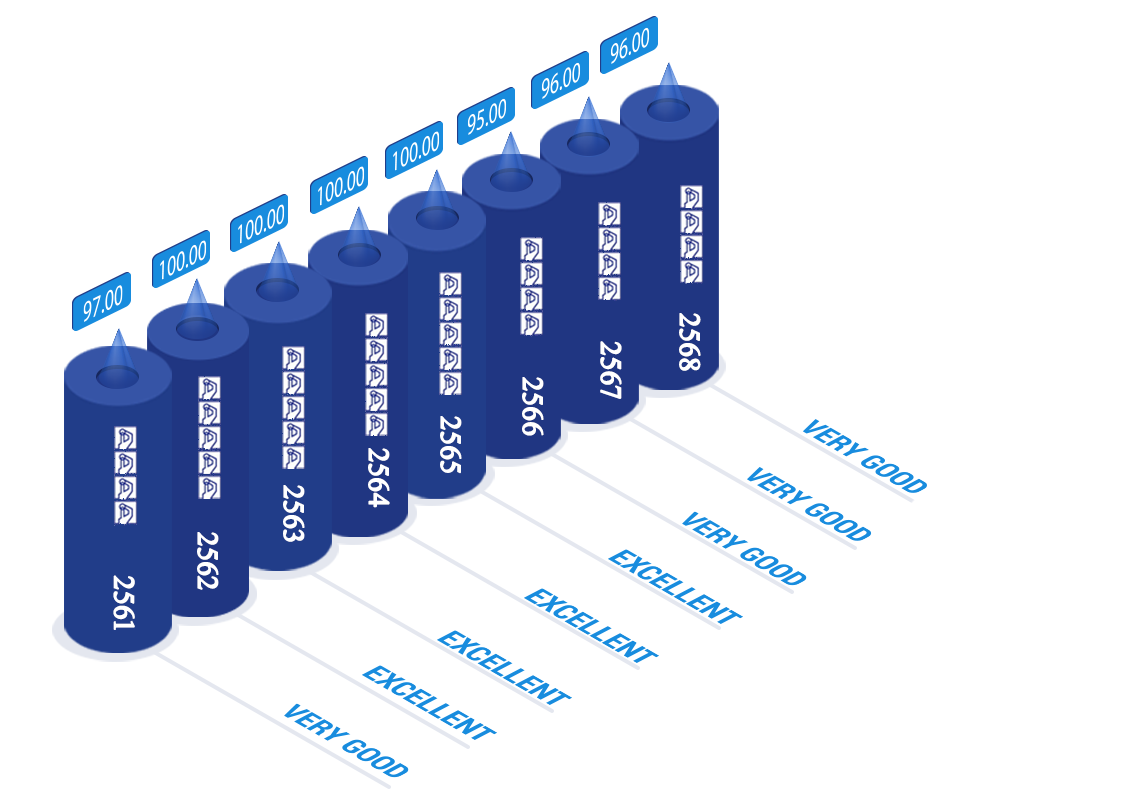
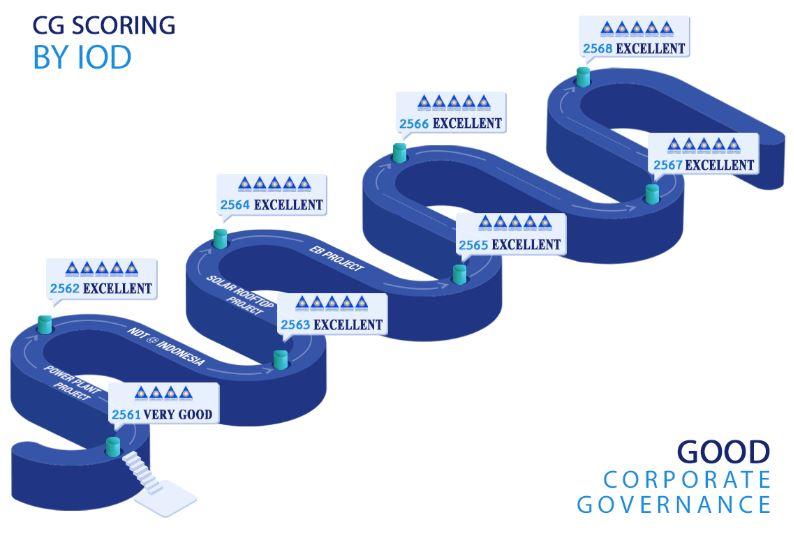
The Company received an "Excellent" rating in the 2025 Corporate Governance Report of Thai Listed Companies from the Thai Institute of Directors Association for a period of 10 consecutive years with a score of 98 points.
Shareholder Meeting Quality Assessment Project
The Company adheres to the principles and guidelines in the "AGM Checklist" manual set by the Thai Investors Association. The Company received a quality assessment score of 96 for its 2025 Annual General Meeting of Shareholders.
Implements the CG Code for Listed Companies
No
CG Code — Description
Good Corporate Governance Policy
The Board of Directors recognizes the importance of promoting and creating value for the sustainable growth of the company and its subsidiaries, encompassing business operations, management, and governance. Therefore, it prioritizes fair, transparent, auditable, and responsible management towards all stakeholder groups in the value chain, based on professional ethics, morality, and good virtues. This aims to establish higher business standards and create maximum value efficiently, thereby building trust among all stakeholder groups, enhancing the organization's positive image, and leading to truly sustainable business operations. The Board is committed to acting as a good role model as follows:
(1) The Board of Directors adheres to policies and guidelines related to the performance of its duties, covering the recruitment and remuneration of directors and senior executives, independence from management, director development, and performance evaluation, as well as the oversight of subsidiaries and associated companies, and other related matters.
(2) The Board of Directors shall define the company's vision, mission, commitment, policies, management structure, strategies, objectives, goals, business plans, budget, and operational direction, as well as risk management measures, and shall monitor and review their suitability annually.
(3) The Board of Directors shall define roles and operational guidelines with sufficient independence, transparency, and the ability to systematically inspect, monitor, and measure performance. It shall effectively manage risks, including carefully considering the regulations of all countries where investments are made, and shall be responsible for its performance in accordance with good corporate governance principles, relevant rules, regulations, and laws.
(4) The Board of Directors shall ensure the safety of personnel, assets, and the environment, both within the organization and in nearby communities. This includes the appropriate allocation of critical resources, by adapting technology and innovation to be suitable and by implementing access prevention systems, to ensure that duties are performed effectively and efficiently as prescribed.
(5) The Board of Directors encourages employees at all levels to adhere to good corporate governance principles, as well as policies and guidelines related to all groups of shareholders and stakeholders, covering shareholder care, equal treatment, promotion of shareholder rights, prevention of insider trading, prevention of conflicts of interest, responsibility towards all stakeholder groups, compensation in cases of rights violations, including anti-corruption, and measures to address those who do not comply with such policies and guidelines.
(6) The Board of Directors encourages employees at all levels to strictly comply with the company's operational procedures and regulations, including the requirements and announcements of the Stock Exchange of Thailand, the Securities and Exchange Commission, and laws related to business operations. It also continuously monitors changes and promotes both external and internal training for personnel to continuously enhance their potential.
(7) The Board of Directors shall regularly consider, review the suitability of, and approve the good corporate governance policy at least once a year, and shall also establish a system for inspection, monitoring, evaluation, and review to ensure that employees at all levels adhere to and fully comply with it for true sustainability.
The Board of Directors has therefore established this written Good Corporate Governance Policy to encourage directors, executives, and employees at all levels to adhere to and comply with it, based on a strong sense of responsibility towards society, the community, and the environment, in line with the sustainable development guidelines of relevant agencies. The Audit Committee is assigned to oversee and review its implementation, reporting the results of good corporate governance operations to the Board of Directors at least once a year or whenever there are relevant changes. The results shall also be reported to the public through the Annual Information Form / Annual Report (Form 56-1 e One Report), Sustainability Report (SD Report), and the company's website (www.tndt.co.th).
Other CG Performance & Outcomes
Corporate Governance Report of Thai Listed Companies (CGR) Survey Project
Since 2019, the Company's Board of Directors has considered, reviewed, and monitored operations, and has adopted the 8 principles of good corporate governance (CG Code) of the SEC Office. Additionally, in 2025, the Corporate Governance Report of Thai Listed Companies for the year 2024 or CGR 2025 from the Thai Institute of Directors Association has been applied and adapted to ensure the company achieves good performance, maintains credibility with all stakeholders, benefits society as a whole, and creates sustainable value for the business.
The Company received an "Excellent" level assessment for corporate governance of listed companies for the year 2025 from the Thai Institute of Directors Association for 10 consecutive years with a score of 98 points.
Shareholders' Meeting Quality Assessment Project
The Company adheres to the principles and guidelines in the "AGM Checklist" manual set by the Thai Investors Association. The Company received a quality assessment for its Annual General Meeting of Shareholders for the year 2025 with a score of 96 points.